Why Is the Seller Selling?
October 26, 2026 · Negotiation · 2 min read
Most buyers assume sellers sell for money.
Money matters. But it is rarely the only answer.
In Driven, Paul Lawrence and Nitin Nohria describe four forces behind human choices: acquire, bond, learn, and defend.
While not intended for it, they also provide a useful dealmaking checklist.
Is the seller trying to maximize their payout? Protect employees or a family legacy? Find capabilities the company cannot build alone? Reduce a risk that has become uncomfortable? Or have family members that don't want to run the business?
If you misunderstand the seller's motivation, you can offer the right price and still propose the wrong deal.
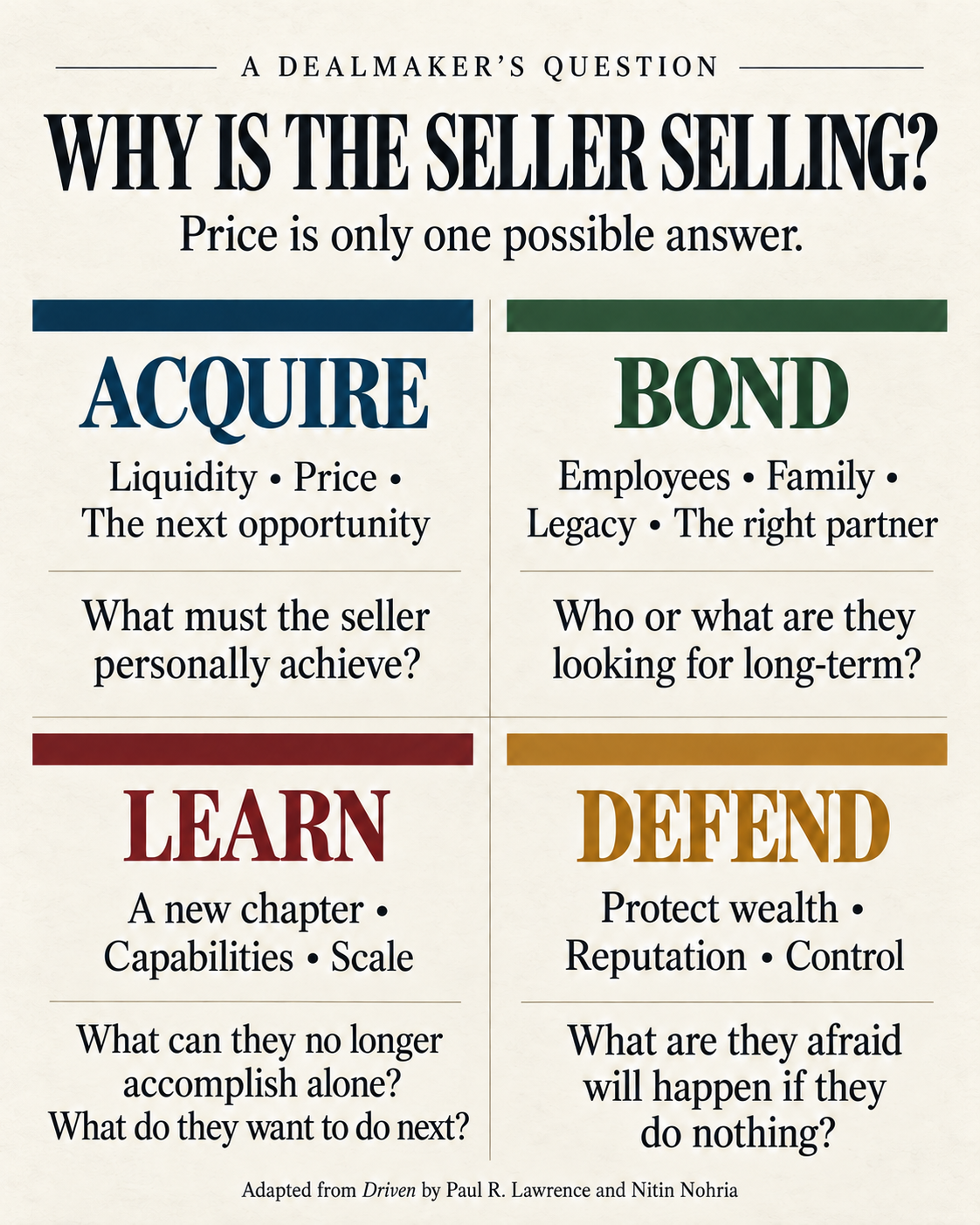
Four questions to ask
- Acquire: liquidity, price, status, or the next opportunity. Ask: What must the seller personally achieve?
- Bond: employees, family, legacy, or the right partner. Ask: Who or what are they looking for long-term?
- Learn: a new chapter, capabilities, or scale. Ask: What can they no longer accomplish alone? Or what do sellers want to do next?
- Defend: protect wealth, reputation, or control. Ask: What are they afraid will happen if they do nothing?
Good dealmakers don’t ask only, “What does the seller want?”
They also ask, “Why do they want it?”
The four drives come from Lawrence and Nohria’s Driven: How Human Nature Shapes Our Choices. This is my adaptation of the framework for seller conversations, not a matrix presented by the authors. For more on their work, see Harvard Business School Working Knowledge and the publisher’s book page.
Enjoyed this? Get the next one.
Join the list for new essays on deals, capital, books, and business.
Related reading
Making M&A Work
A Short LOI Can Be a Virtue. A Vague One Is Not.
A letter of intent should define the terms that determine what a seller actually receives.
September 28, 2026 · 2 min read
Making M&A Work
The Most Important Page in an LOI
Everyone reads the price. The page that decides whether you'll be happy in two years is the one dictating what happens between signing and closing.
May 12, 2026 · 2 min read
Making M&A Work
The Deal Dip
Performance often dips before a transaction and again after closing. Plan for both.
October 21, 2026 · 3 min read